
There’s a specific moment when homeowners realize something has changed.
You’re walking down the steps. You’ve walked those same steps for years. And suddenly your feet notice it before your eyes do.
It doesn’t feel smooth anymore.
It feels scratchy. Grainy. Almost like very fine sand stuck to concrete.
Most people assume the pool just needs brushing. Or that it’s scale. Or maybe the chemicals are off.
Sometimes that’s true.
Often it isn’t.
After resurfacing and repairing pools for decades, I can tell you this: when a pool feels rough, it’s usually the surface itself talking to you.
And it’s worth listening.
What That Texture Actually Is
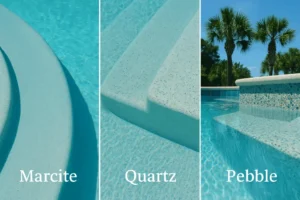
Pool plaster is not a hard, impenetrable shell. It’s a cement-based finish with aggregate mixed in. When it’s new, it’s dense and tight. Over time, water chemistry, sun, heat, and circulation slowly work on it.
The cement portion wears first.
When that happens, the harder aggregate inside the plaster becomes more exposed. You start feeling the tiny stones instead of the smoother binder that used to hold everything flat.
That’s one kind of roughness.
Another kind shows up when calcium forms nodules in small surface cracks. You’ll feel small bumps, sometimes concentrated in certain areas.
And then there’s the more serious kind. When the plaster matrix begins to weaken and shed. If you brush the wall and see fine dust or grit collect along the tile line, that isn’t dirt. That’s material coming off the surface.
That is no longer cosmetic.
Florida Is Not Gentle on Plaster
In Northeast Florida, finishes age differently.
The heat alone changes the equation. Water evaporates faster. Minerals concentrate. Chemical demand increases. If the pool ever went through long stretches of poor balance, the surface remembers.
I’ve seen pools that looked fine from a distance, but once drained, the plaster was etched and brittle. The owners thought they had a staining problem. What they really had was a surface that had slowly lost its density.
Swimming pool plastering done properly can last many years here. But even the best installations have a lifespan. Sun, salt systems, heavy use, and inconsistent chemistry all shorten it.
Roughness is often the first physical sign that time is catching up.
Not Every Rough Pool Needs to Be Resurfaced
This is important.
Some roughness can be isolated. Maybe it’s limited to steps or a shallow shelf. Maybe it’s related to a localized chemistry issue or minor scale buildup.
In those cases, swimming pool plaster repair might be enough. Small sections can be addressed without committing to a full overhaul.
But when the texture is consistent across the entire pool, that’s different. When brushing no longer restores smoothness. When stains come back quickly. When the surface feels increasingly abrasive year after year.
That is usually when pool plaster resurfacing becomes the practical conversation.
Not because it looks bad. Because the surface has lost its structural integrity.
The Part Homeowners Don’t See
When we drain a pool and chip back failing plaster, the story underneath becomes clear.
Sometimes the bond coat from a previous job was thin.
Sometimes the prep work was rushed.
Sometimes the plaster mix was too rich or too lean.
Sometimes the pool simply reached the end of its service life.
From the outside, all of those situations feel the same under your feet.
Rough.
But the solution depends entirely on the cause.
That’s why guessing rarely helps. And why throwing more chemicals at it almost never fixes the problem long term.
If You’re Feeling It, It’s Time to Ask Questions
If your pool feels rough, here are a few practical signs to pay attention to:
- Do you see fine white dust collecting after brushing?
- Are stains harder to remove than they used to be?
- Does the surface feel sharper in certain areas?
- Has it been more than 12 to 15 years since the last resurfacing?
If the answer to several of those is yes, the surface is likely aging out.
That does not mean panic. It means plan.
A Straight Answer
A smooth finish is not just about comfort. It protects the shell of the pool. It keeps water chemistry more stable. It reduces algae anchoring points. It makes maintenance easier.
When that finish starts to break down, the earlier you evaluate it, the more options you usually have.
At All County Pool Services, we have been resurfacing and repairing pool finishes in Jacksonville since 1999. We have seen every version of “rough” there is. Some need minor repair. Some need full resurfacing. The only way to know is to look at the surface closely and honestly.
If your pool does not feel the way it used to, it might be worth having someone take a real look before small wear turns into larger damage.
Your feet noticed it for a reason.